 Christian Beatty
A new client signs and pays the first invoice. The team starts the work. Six weeks later, the client cancels. Or the second payment fails, and the client does not reply to your emails.
Many agency owners tell me the same thing: "New clients leave after one or two payments." The sales call was good. The client said yes. But the agency lost the client before the work could show results.
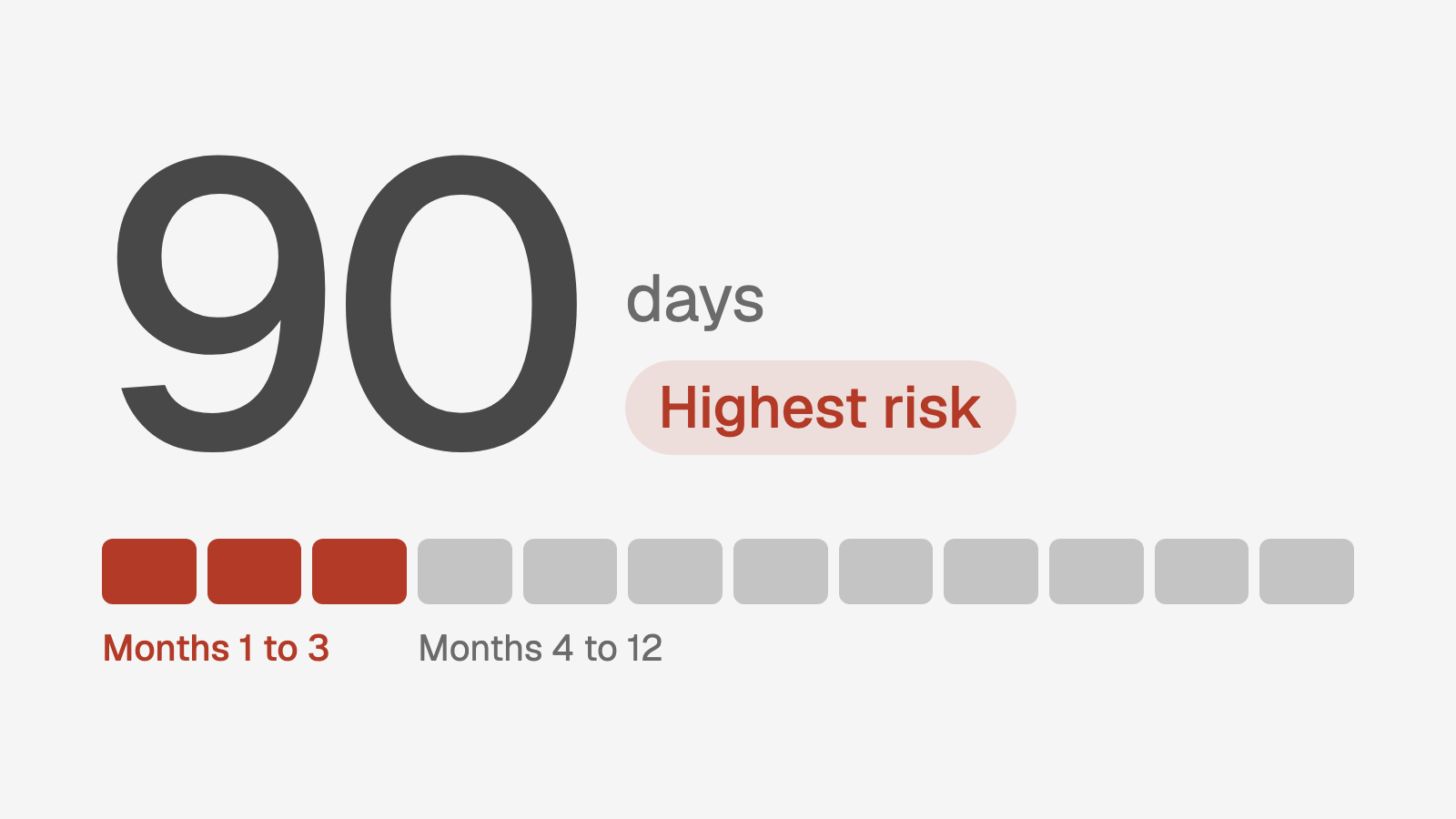
This post shows the numbers from a local SEO agency with approximately 85 clients. I built the operations system for this agency. The post explains why the first 90 days have the highest risk. It also shows what to do in each of the first three months. At the end, there are steps that you can start this week without software.
The numbers: one new client in five paid only once
In 2026, 58 new clients started with the agency. Of these clients, 12 paid only once. That is approximately one new client in five.
The cancellation rate also changes with time as a client. The table shows the percent of clients who cancelled each month.
Time as a client | Clients who cancelled each month |
|---|---|
Months 2 and 3 | 9 to 12 percent |
Months 4 to 12 | Approximately 6 percent |
After one year | Less than 5 percent |
In months 2 and 3, the rate is 1.5 to 2 times the rate of months 4 to 12. A client who stays for one year is much more stable. Because of this, the first 90 days have a large effect on your revenue for the full year.
The risk score that I built for the agency uses this data. Time as a client is one of its signals. The table shows the points for each period.
Time as a client | Risk score points |
|---|---|
Month 1 | 15 |
Months 2 and 3 | 25 |
Months 4 to 12 | 10 |
After one year | 0 |
Months 2 and 3 receive the most points because these months had the highest cancellation rate. One more rule applies to new clients: the risk score does not count silence (no email) in the first month. You can read all the signals and their points in how to spot which clients will cancel 30 to 60 days before they do.
Why months 2 and 3 have the highest risk
In month 1, the client expects setup work. The team does the onboarding call, receives the access, and starts the work. The client sees activity, and for now that is enough.
In months 2 and 3, the client pays again. Now the client asks: what do I receive for this money? For local SEO, the honest answer is often "not much that you can see yet."
SEO results take months. First, the team does keyword research, changes the website pages, and writes new content. Then search engines must find and rank the changes. Calls and leads from search come after that.
Because of this, there is a gap. The client paid two or three times, but the results are not visible yet. If nobody explains the gap, the client possibly thinks that the decision was wrong.
Three problems make the gap larger:
No written expectations. The sales call promised results, but nobody said when.
Access that the client did not send. Without the website login, the work cannot start. Each week of delay moves the results back one week.
No contact. The client hears from the agency only when the invoice arrives.
The agency records a reason for each cancellation. Two of the reasons are "no visible results" and "slow communication." Both problems can start in the first weeks, long before the client cancels.
The first 90 days, month by month
Below is what the agency system and the team do in each month.
Day 1: the won deal creates the client
The sales team marks a deal as won in GoHighLevel. Then the system creates the client automatically. It links the client to the GoHighLevel contact and copies the name, email, phone and website. The client shows at the top of the client list as a new client with no services yet.
A team member opens the client and selects the services that the client bought. The system creates a setup task for each service. Where a service has a monthly deliverable, it also creates the first one. It also adds the onboarding process, so the onboarding steps go into the work queue.
Nobody copies data from one tool to another. Nobody forgets to start onboarding. A team member sets the monthly fee, the start date and the billing on the client record.
The sales team sets expectations before day 1. On the sales call, the team confirms that the client can pay for the service for at least six months. The team does not promise results in the first month.
Month 1: expectations and access
The aim of month 1 is a clear start. The client must know what the team does, when it does it, and what the client must send.
Write down the timeline. After the onboarding call, the system creates a task to send a one-page timeline. The page shows the work for months 1, 2 and 3.
Say when results can start. The timeline says that SEO results take months. It gives a realistic month for the first results in search.
Track the items that the client must send. A task can have the setting "done by the client."
Give each client item to one person. The system gives the task to the lead for that service. This person follows up with the client.
Add risk points for late client items. The risk score adds 10 points after 14 days and 20 points after 30 days.
Ask again for access in days, not weeks. If a login is not there after 3 business days, the system creates a task to call the client.
A phone call is faster than a fourth email. The work cannot start until the access is there.
Month 2: a first visible win
In month 2, the second payment occurs. The client must see one result before or near that date. It does not have to be a ranking. It must be a result that the client can see and understand.
These are examples of a first visible win for a local SEO client:
A new or improved service page, live on the website
An updated Google Business Profile with new photos and posts
The list of keywords that the team will target, with the search volume for each keyword
The first monthly report, with the work done and the plan for next month
In month 2, the system creates a task to send the win. The team sends it in a short message with one link or one screenshot. The message says what the team did and why it is important for the business of the client.
The risk score adds 25 points to each client in months 2 and 3. Because of this, one more problem moves a new client up the list quickly. For example, a client email with no reply for 2 days adds 20 points. Together, that is 45 points, which is the level "watch."
Month 3: the check-in
Month 3 is the last month with the highest cancellation rate. The client has paid three times. This is the correct time for a planned conversation.
Schedule the check-in early. The system schedules the month 3 check-in when the client starts.
Show the trend, not the task list. The account manager compares calls, leads and rankings with month 1.
Show early signs if results are still small. Examples are impressions in search, new pages, and new reviews.
Ask one direct question. "Is this what you expected at this point?" The account manager listens before they explain.
Record the answer on the client record. The next person who talks to the client can then read it.
The system schedules a check-in at months 1, 3 and 6. The team records the result of each check-in on the client record.
The early-life rule
The risk score has one more rule for new clients. It uses three colors for each signal: green, yellow and red. The rule is: in the first 90 days, a yellow (watch) signal counts as red (at risk).
The system applies this rule automatically to each client in the first 90 days.
For example, one late deliverable is a small problem for a client of three years. For a client in month 2, the same late deliverable is a reason to call this week. In the first 90 days, one problem is enough for action.
Sample client: Lakeside Dental, month 2
The monthly report is 3 days late. A request to the client for Google Business Profile access is 8 days overdue.
For a client of three years, these are yellow signals. In the first 90 days, it counts as red. The account manager calls the client this week.
This is a sample client. The name and the details are not real.
When a client turns red, the system adds the save flow to the client automatically. The steps are in the risk score post.
Start this week
These steps do not use software. A spreadsheet or a sheet of paper is enough. Count only clients with a monthly fee.
Make a list of all clients who started in the last 90 days.
Write the start date and the month as a client next to each name.
For each client, write one result that the client can see today.
Mark each client who has no visible result yet.
For each marked client, choose one win that the team can deliver in 2 weeks.
List the access and approvals that each new client did not send.
Call each client who did not send access.
Write a one-page timeline for months 1, 2 and 3.
Send the timeline to each new client.
Put a check-in call in the calendar for each client in month 3.
Agree on the early-life rule with your team.
Count the clients who started this year and paid only once.
Do step 12 again each quarter. If the number decreases, the first 90 days work better.
How does your agency score?
Client retention and onboarding are two of the eight areas in the free agency systems quiz. The quiz has 14 questions and takes 5 minutes. You receive a score out of 100 and your three largest gaps.
Take the 5 minute quiz. Or book a call, and I will show you how a system like this can work in your agency.